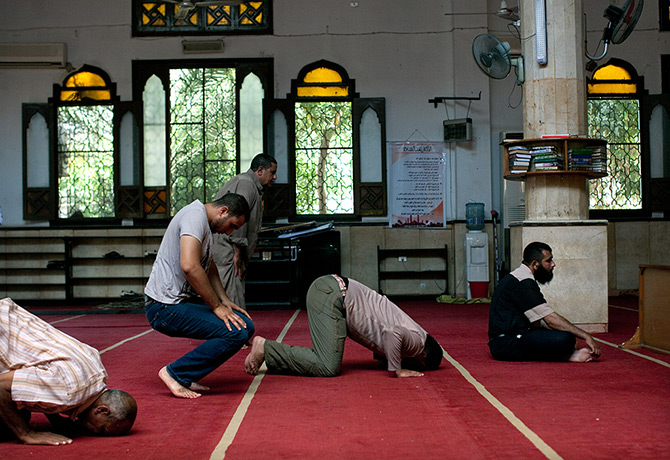
The Times of Israel is reporting that the spiritual leader of the Muslim Brotherhood is suspected of being behind several tweets telling members to quit fasting for Ramadan so they’ll be strong enough to battle for ousted Mohammed Morsi’s return.
يجوز للأخوة المتظاهرين لاستعادة الشرعية الإفطار في رمضان، لأنهم في حالة جهاد.
— أ.د محمد بديع (@Dr_MohammedBadi) July 15, 2013
قصيدة دولة الأخوانجية للعظيم (( بيرم التونسي )) - يتخيل فيها مصر تحت حكم الاخوان سنه 1954 .. اقراها واستمتع كتبها من 60 سنه لما هتقرأها هتلاقى ان جماعه الاخوان مختلفوش خالص من 60 سنه =============================== كفاية يا مصر لو يبقى الهضيبي وأعوانه على عرش الامارة وسيد قطب يعطوه المعارف وسيد فرغلي ياخد التجارة وعودة يعودوه ضرب المدافع وسي عبد الحكيم عابدين سفارة وسي عبد العزيز أحمد يسوقها ويتولى المواصلات بالاشارة وكل جهاز تتعين عيله عمد في كل قريه وحارة محافظ مصر خريج الدباغة وتحته وكيل خريج النجارة ويقني الكمساري أكبرها عزبة ويقني السمكري أضخم عمارة وتخلص مصر من عيلة الدخاخني الى عيلة الخواتكي أو شرارة ويومها تحلق الاخوان دقونها ويترص الحشيش ملو السيجارة ووحياتك لا أيد اللص تقطع ولا تبطل مواخير الدعارة ويبقى الشعب هواه في الفلافل وطرشي الحاج سيد والبصارة
In November 2011, after I joined a protest
on Mohamed Mahmoud Street in Cairo with a friend, Egyptian riot police
beat me – breaking my left arm and right hand – and sexually assaulted
me. I was also detained by the interior minister and military
intelligence for 12 hours.
After I was released, it took all I had
not to cry when I saw the look on the face of a very kind woman I'd
never met before, except on Twitter, who came to pick me up and take me
to the emergency room for medical attention. (She is now a cherished
friend.)
As I described to the female triage nurse what had had happened to me, she stopped at "and they sexually assaulted me" to ask:
how could you let them do that to you? Why didn't you resist?
-->
It
had been about 14 or 15 hours since riot police had attacked me; I just
wanted to be X-rayed to see if they had broken anything. Both arms
looked like the Elephant Man's limbs. I explained to the nurse that when
you're surrounded by four or five riot police, whacking at you with
their night sticks, there isn't much "resisting" one can do.
I've
been thinking a lot about that exchange with the nurse. Whenever I read
the ghastly toll of how many women were sexually assaulted during last
week's protests against Mohamed Morsiin Tahrir Square, I have to wonder about such harshness after brutality.
Activists
with grassroots groups on the ground who intervene to extricate women
from sexual violence in Tahrir said they documented more than 100 cases;
several were mob assaults, several requiring medical attention. One
woman was raped with a sharp object. I hope none was asked "why didn't
you resist?"
This isn't an essay on how Egyptian regimes like
Mubarak's targeted female activists and journalists as a political ploy.
Nor is it about how regimes like Morsi's largely ignored sexual
violence, and even when it did acknowledge it, blamed women for bringing
assaults upon themselves. Nor is it an article about how such assaults
and such refusal to hold anyone accountable have given a green light to
our abusers that women's bodies are fair game. Nor will I tell you that –
were it not for the silence and denial surrounding sexual assault in Egypt – such assaults would not be enacted so frequently on women's bodies on the Egyptian streets.
I
don't know who is behind those mob assaults in Tahrir, but I do know
that they would not attack women if they didn't know they would get away
with it and that the women would always be asked "why didn't you
resist?"
From the ground up, we need a national campaign against
sexual violence in Egypt. It must push whoever we elect to govern Egypt next, as well as our legislators, to take sexual assaults more
seriously.
If our next president chooses – as Morsi did – to
address the nation from a stage in Tahrir Square for the inauguration,
let him (or her) salute the women who turned out in their thousands upon
thousands in that same square, knowing they risked assaults and yet
refusing to be pushed out of public space. The square's name literally
means "liberation", and it will be those women who, in spite of the risk
of sexual violence, will have helped to enable his (or her) presence
there as the new president of Egypt.
Undoubtedly, the Egyptian
interior ministry needs reform, especially when it comes to how it deals
with sexual assault. The police rarely, if ever, intervene, or make
arrests, or press charges. It was, after all, the riot police themselves
who assaulted me. Their supervising officer even threatened me with
gang rape as his conscripts continued their assault of me in front of him.
-->
Any
woman who ends up in the ER room deserves much better than "why didn't
you resist?" Nurses and doctors need training in how best to care for
survivors of sexual assault and how to gather evidence.Female
police units are said to have been introduced at various precincts, but
they need training. They also need rape kits – in the unlikely event any
woman actually gathers herself enough to report rape in Egypt. When I
was reporting on sexual violence in Cairo in the 1990s, several
psychiatrists told me their offices were the preferred destination for
women who had survived sexual violence, be it at home or on the streets,
because they feared being violated again in police stations.
While
that fear is still justifiable today, something has begun to change:
more and more women are willing to go public to recount their assaults. I
salute those women's courage, but I wonder where they find comfort and
support after their retelling is over. PTSD therapy is not readily
available in Egypt. We need to train more of our counsellors to offer it
to those who want it.
We need to recruit popular football and
music stars in advertising campaigns: huge, presidential election
campaign style billboards across bridges and buildings – addressing men
with clear anti-sexual violence messages, for example – as well as
television and radio spots. Culture itself has a role to play in
changing this culture: puppet theatre and other arts indigenous to Egypt
can help break the taboo of speaking out; and we need more TV shows and
films that tackle sexual assaults in their storylines.
There is
an innate and burning desire for justice in Egypt. Revolutions will do
that. We need to coordinate efforts and aim high to ensure such a
campaign meets the needs of girls and women across the country, not just
Cairo and the big cities.
In January 2012, I spent a few days
with a fierce 13-year-old girl we'll call Yasmine, for a documentary
film, on which I was a writer, called Girl Rising. The film paired nine
female writers with girls each from their country of birth whose stories
they recounted to illustrate the importance of girls' education.
Five
months before we met, Yasmine had survived a rape. My arms were still
broken and in casts when we met and I naively considered removing the
casts and pretending I was OK in order to "protect her". I did not want
her to think that 30 years down the line, at my age, she could still be
subject to such violation.
She certainly did not need my
protection and I'm glad I kept my casts on, because as soon as we met,
she simply and forthrightly told me:
I'm going to open my heart to you and you're going to open your heart to me, OK?
She
then went on to recount what happened to her. I admired her courage and
her insistence on going to the police with her mother to report the
rape. She was lucky she found an understanding police officer who took
her complaint seriously.
When I told her what had happened to me,
she was shocked that it was police who'd attacked me. "Have you reported
what happened to you? Have you taken them to court?" she asked me.
Yasmine has not had a single day of formal education. She believed she deserved justice. We all do.